


The International Maritime Institute of Nigeria (IMION) has called for a comprehensive overhaul of Nigeria’s maritime logistics and trade facilitation systems, stressing that efficient logistics is critical to unlocking the country’s blue economy potential.
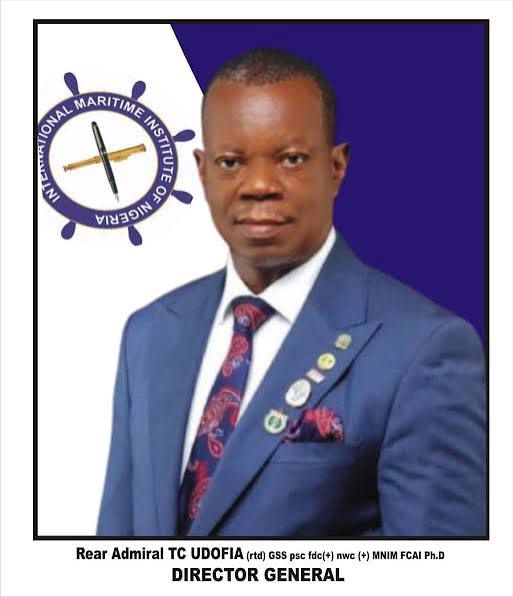
The Director General of IMION, Rear Admiral Thaddeus Udofia (rtd), made the call on Monday in Lagos at a three-day Executive Course on Logistics and Trade Facilitation for Blue Economy Growth at the Institute.
Udofia said Nigeria’s ambition to become a competitive maritime and logistics hub in Africa could not be achieved without addressing inefficiencies in the movement of goods, people, information and services across the country’s maritime and trade corridors.
He noted that Nigeria’s extensive maritime domain, including its coastline, Exclusive Economic Zone (EEZ), inland waterways, creeks, estuaries and coastal resources, presents enormous opportunities for economic growth, job creation, trade expansion and regional integration.
According to him, the challenge lies in effectively converting these resources into sustainable economic prosperity through efficient logistics and trade facilitation.
The IMION DG also stressed the need for stronger collaboration among Customs, port authorities, regulatory agencies, shipping and logistics companies, freight forwarders, transport operators, technology providers and financial institutions.
He warned against institutional silos, saying the development of the blue economy required greater collaboration, digitalisation, transparency, interoperability and coordinated policy implementation.
He said technology and data should be deployed more effectively to facilitate cargo clearance and enhance visibility across supply chains, while public and private institutions must work together to create a more efficient maritime business environment.
He said the Executive Course was designed to examine these challenges from both strategic and practical perspectives, with emphasis on modern logistics systems, customs procedures, port operations, multimodal transportation, supply-chain management and contemporary trade facilitation approaches.
Udofia urged participants to approach the programme as an opportunity to share experiences, challenge existing practices and develop solutions that could be implemented beyond the three-day event.
The course’s learning objectives include mapping Nigeria’s key maritime corridors, diagnosing inefficiencies in maritime logistics and customs systems, evaluating trade facilitation tools and regulatory frameworks, and developing a logistics and trade facilitation roadmap capable of driving profitability across blue economy subsectors.
As part of the Institute’s institutional milestones, Udofia also unveiled the Second Edition of the IMION Newsletter, describing the publication as a platform that would chronicle important developments and innovations within Nigeria’s maritime industry and the wider Gulf of Guinea.
He expressed appreciation to the Chief of the Naval Staff, Vice Admiral Idi Abbas, for his support to the Institute, particularly in facilitating the participation of Nigerian Navy officers in the executive course.
He also acknowledged the Institute’s Board of Trustees, Governing Board, maritime stakeholders, partner organisations, consultant Paul Usoro & Co., and members of the faculty for their contributions to the programme and the Institute’s development.
The programme attracted senior representatives of the Nigerian Navy, Nigeria Customs Service, Nigerian Ports Economic Regulatory Agency, port authorities, maritime organisations, government institutions, private sector operators, academia, research institutions, logistics and freight organisations, among other stakeholders.