


By ANDREW UTULU
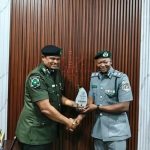
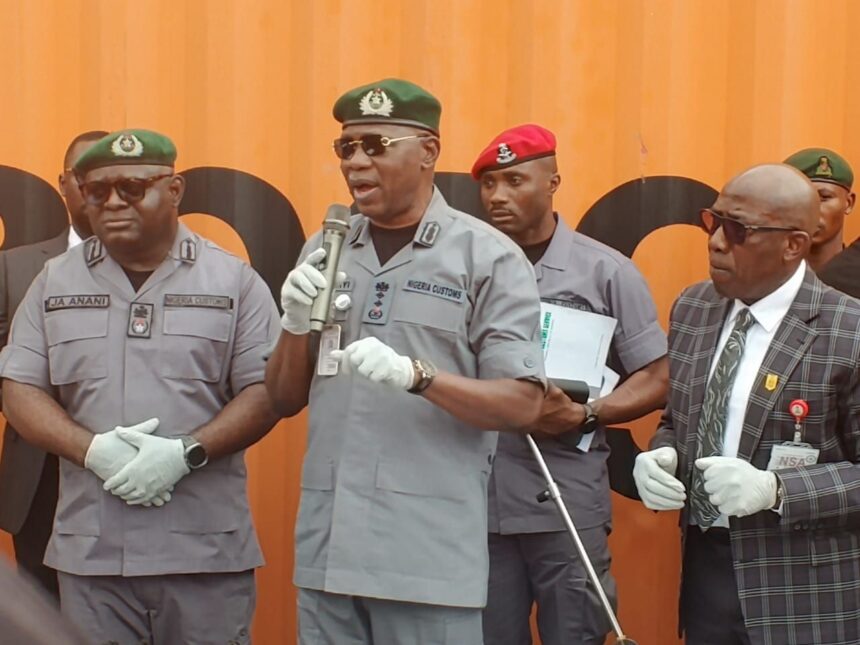
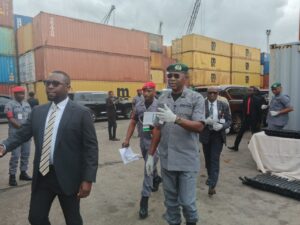
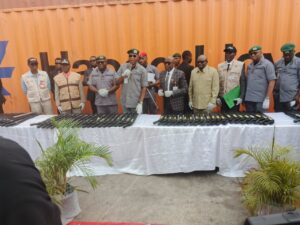
The Comptroller-General of the Nigeria Customs Service, Bashir Adewale Adeniyi on Monday in Lagos, handed over 399 fully assembled JGF pump-action rifles and 535 assorted firearm components intercepted at the Tin Can Island Port, Lagos, to the National Centre for the Control of Small Arms and Light Weapons (NCCSALW).
Adeniyi averred that the Service would continue to protect lives and property as well as protecting the economy of the Nations through waging wars against smuggler and economic saboteurs.
The CGC stressed that the seizure prevented the weapons from reaching their intended destination and potentially falling into the hands of criminal elements.
According to him, the consignment, which arrived at Tin Can Island Port on July 8 aboard MV Velika, was intercepted after being flagged by the Customs risk management system.
He explained that the firearms had been dismantled and concealed in knockdown form, describing the method as a deliberate attempt to make the weapons less recognisable during cargo examination.
The CGC said the subsequent examination and coupling of the components had been completed, revealing 399 fully assembled rifles and 535 assorted components. Among the components recovered were 89 frames, 80 charging handles, 579 trigger groups and 25 locking lugs.
Adeniyi said the interception was particularly significant given Nigeria’s ongoing security challenges, including terrorism, banditry, kidnapping and violent crime. He noted that the seizure also came as the country approaches another electioneering season, stressing that hundreds of firearms entering the wrong hands could pose a serious threat to public safety and the democratic process.
The Customs boss said the consignment had failed to reach its intended destination, while efforts were ongoing to establish those behind its importation and intended collection. Adeniyi attributed the interception to the deployment of technology and automated risk management under the administration’s trade modernisation programme.
According to him, Customs cannot physically open every container entering the country, making technology driven risk profiling critical to identifying suspicious consignments. He explained that the risk management system enables the Service to determine which containers require physical examination, adding that the interception demonstrated the effectiveness of the system.
Adeniyi further disclosed that two suspects, identified as Robert Eze and Ejeogu Godson, had been arrested in connection with the consignment. He said one of the suspects was arrested on July 31 at the terminal while attempting to procure the release of the container.
The two suspects, he added, had been remanded by the Federal High Court in Lagos, with their arraignment scheduled for August 25. With the completion of the examination and the arrest of the suspects, the CGC said the firearms had now been formally transferred to the national authority responsible for small arms and light weapons.
He described the development as more than a seizure, noting that the interception, investigation, arrest of suspects, prosecution and handover of the firearms represented a complete enforcement chain.
The CGC also warned that the NCS would not allow Nigeria’s ports and borders to become channels for the movement of arms or other items capable of threatening national security. He pledged that the Service would continue to strengthen intelligence gathering, risk management and collaboration with sister security agencies to identify and disrupt attempts to smuggle firearms into the country.
He commended officers of the Tin Can Island Port Command for their vigilance and professionalism, noting that the firearms had been carefully concealed but were nevertheless detected through the Customs risk management system.
The CGC urged the media to allow the investigation and court process to run their course, particularly on questions concerning the intended destination of the firearms and those behind the attempted importation.
“Look carefully at what is laid out on these tables. Three hundred and ninety-nine rifles. Somebody paid for them. Somebody arranged their shipment. Somebody was waiting at this end to collect them. And somebody, somewhere in this country, was going to be on the wrong end of them. That is what we have gathered this morning to hand over to the National Centre for the Control of Small Arms and Light Weapons.”
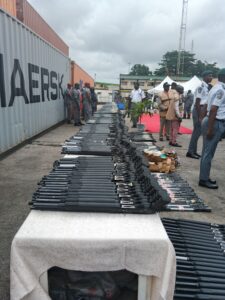
“When we met the press on the 6th of August, we told you the interception had been made, but that the examination and coupling were still going on. That work is now finished, and this is the result. Three hundred and ninety-nine fully assembled JOJEF pump-action rifles. Five hundred and thirty-five assorted component parts, among them 89 frames, 80 charging handles, 57 trigger groups and 25 locking lugs. Every item counted. Every item documented. Nothing left in doubt,” the CGC stated.
The Customs boss lamented the enormous damage this would have done to the country in they have scaled through even at this critical period the country is facing security challenges.
“Now consider what that quantity of weapons would have done. Our country is contending with terrorism. With banditry. With kidnapping. With violent crime that has entered too many homes in this country. And not one of those afflictions can be carried out without a weapon in somebody’s hand. Weapons like these are not made in Nigeria. They are made elsewhere, and they reach us through the ports, the borders and the airports that this Service is charged with guarding. We are also approaching another electioneering season, and I do not need to describe to this audience what several hundred firearms in the wrong hands would mean for the peace of our communities or for the conduct of our democracy. I will say only this: that consignment did not reach its destination, and the officers of this Service are the reason.”
The CGC explained that the container was discovered because of a system, and that system exists because this administration chose to invest in it, pointing out that under the Trade Modernisation Project “we have replaced manual processes with B’Odogwu, which brings clearance, automated risk management, cargo tracking and non-intrusive inspection onto a single platform. The purpose of that investment was never revenue alone. We cannot open every container that enters this country, and no customs administration anywhere in the world can. What technology gives us is the ability to know which container to open. What you are looking at this morning is that capability doing precisely what it was built to do.”
He explained that one of them was arrested on July 31, at a bonded terminal, while he was attempting to procure the release of this very container.
He said both have been remanded by the Federal High Court in Lagos, and arraignment is set for August 25.
“And today the weapons themselves pass into the custody of the National Centre for the Control of Small Arms and Light Weapons, under the Office of the National Security Adviser. Hear that sequence in full, because it is the whole point of this gathering. The weapons were intercepted. The importers were arrested. They stand before a court of law. And the arms are being surrendered to the national authority responsible for them. That is not an incident. That is a chain, and every link in it held.”
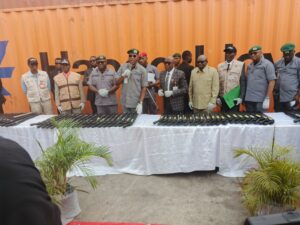
The CGC vowed that the Service would not allow the ports and borders of this country to be used to bring in arms, or anything else that threatens the safety of Nigerians.
“Our officers will stay vigilant. We will sharpen our intelligence. We will strengthen our risk systems. And we will work shoulder to shoulder with our sister agencies to find the people who attempt this and to stop them. And I say one thing to our own personnel, as plainly as I say it to anyone outside this Service: the officer who lends himself to this trade, or who uses his position to ease the passage of such goods, will find no shelter with us.”
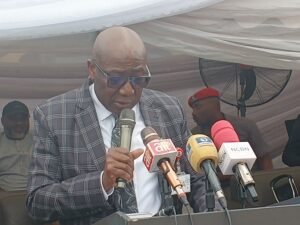
The Director-General of the National Centre for the Control of Small Arms and Light Weapons (NCCSALW), DIG Johnson Babatunde Kokumo (Rtd.), described the handover as more than a transfer of seized items, noting that it represented inter-agency cooperation, accountability and a shared responsibility to protect the peace and security of Nigeria.
According to him, the Customs Service’s role in intercepting and properly accounting for controlled items was critical to the Federal Government’s efforts to combat the illicit movement and proliferation of small arms and light weapons.
DG expressed appreciation to the CGC for his leadership and for facilitating the handover.
He also commended officers and men of the Tin Can Island Port Command for their role in the interception, stressing that continued cooperation between the Customs Service and the Centre would contribute significantly to national security.
Kokumo expressed confidence that the partnership between both institutions would continue to yield positive results in the fight against illicit arms proliferation and strengthen efforts to safeguard the country.