



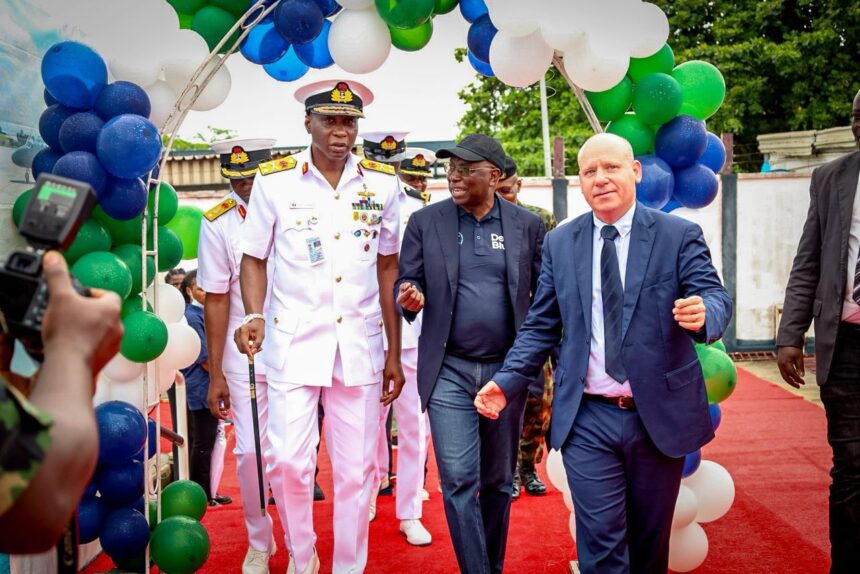
L-R: Representative of the Chief of Naval Staff, Flag Officer Commanding (FOC) Western Naval Command, Rear Admiral Abdullahi Mustapha, Director General Nigerian Maritime Administration and Safety Agency, NIMASA Dr. Dayo Mobereola and Chief Executive Officer, HLSi, Tal Spektor, during the Deep Blue maritime training graduate ceremony in Lagos.
The Chief of the Naval Staff, Vice Admiral Idi Abbas has reaffirmed the importance of sustained inter-agency collaboration in strengthening Nigeria’s maritime security architecture.
The Naval Chief stated this at the graduation ceremony for personnel trained under the Nigerian Maritime Administration and Safety Agency’s Deep Blue Project.
Represented by the Flag Officer Commanding, Western Naval Command, Rear Admiral Abdullahi Mustapha, Vice Admiral Abbas described the Deep Blue Project as a model for effective inter-agency cooperation in tackling maritime crimes and sustaining security within Nigeria’s waters and the Gulf of Guinea.
According to him, “The Deep Blue Project remains a classic example of effective inter-agency collaboration. Modern national security demands sustained cooperation, professionalism, vigilance, and continuous capacity development among all maritime stakeholders.”
He commended the graduands for their professionalism and operational efficiency during the capability demonstration, noting that the training marks a renewed commitment to safeguarding Nigeria’s maritime domain.
“The performance displayed by the participants during the capability demonstration was surgically executed, reflecting the quality of training and operational preparedness required to secure our maritime domain,” the Naval Chief stated.
The Chief of Naval Staff, also lauded the Director General of NIMASA, Dr. Dayo Mobereola, for the sustained investment in maritime security capacity development, while reaffirming the Nigerian Navy’s commitment to supporting initiatives aimed at improving maritime safety, security, and national stability.
Also speaking at the event, the Director General of NIMASA, Dr. Dayo Mobereola, stated that the Agency remains committed to strengthening maritime security through strategic partnerships, continuous capacity development, and sustained investment in the Deep Blue Project.
Mobereola emphasised that the 177 graduands comprised of 33 Special Mission Vessel Officers, 14 Special Mission Vessel Engineers, 107 Fast Intervention Boat Operators, Technicians and Boarding Team personnel, as well as 23 Helicopter Team members who underwent specialised training in helicopter operations, tactical boat manoeuvres, medical evacuation, unmanned aerial systems, communications, and combat medic procedures.
“These specialised trainings are designed to improve operational efficiency, intelligence coordination, and rapid response capabilities within Nigeria’s maritime domain and the Gulf of Guinea,” Mobereola said.
He noted that Nigeria has maintained zero piracy incidents for four consecutive years through the instrumentality of the Deep Blue Project, leading to reduced war-risk insurance premiums and improved global maritime confidence.
“For four consecutive years, Nigeria has maintained zero piracy incidents in its waters. This achievement has not only restored global confidence in our maritime domain, but was also a significantly contributor to Nigeria’s election into the Category C of the International Maritime Organization,” he stated.
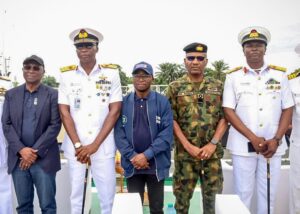
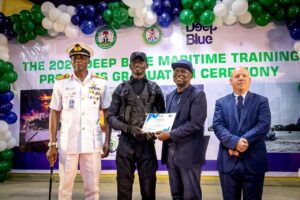
L-R: Director General Nigerian Maritime Administration and Safety Agency, NIMASA Dr. Dayo Mobereola, representative of the Chief of Naval Staff, Flag Officer Commanding (FOC), Western Naval Command, Rear Admiral Abdulahi Mustapha; a graduand and Chief Executive Officer, HLSi, Tal Spektor, during the Deep Blue maritime training graduate ceremony in Lagos.
The NIMASA DG expressed appreciation to the Minister of Marine and Blue Economy, His Excellency Adegboyega Oyetola, “whose sustained support and dedication to the growth of the maritime industry and advancement of the blue economy agenda continue to inspire the Agency’s operations and strategic direction.”
He also commended the Nigerian Armed Forces, Homeland Security International (HLSI), the Department of State Services (DSS), the Nigerian Police Force, and other stakeholders for sustaining the successes recorded under the Deep Blue Project.
He reaffirmed NIMASA’s commitment to deepening collaboration with relevant security agencies and maritime stakeholders to sustain the gains of the Deep Blue Project and ensure safer waterways capable of supporting Nigeria’s maritime and blue economy aspirations.
High point of the event was the operational capability demonstration utilizing the Special Mission Vessel, helicopters, fixed wing aircraft and fast interceptor boats to execute a daring rescue of a merchant vessel under attack.