


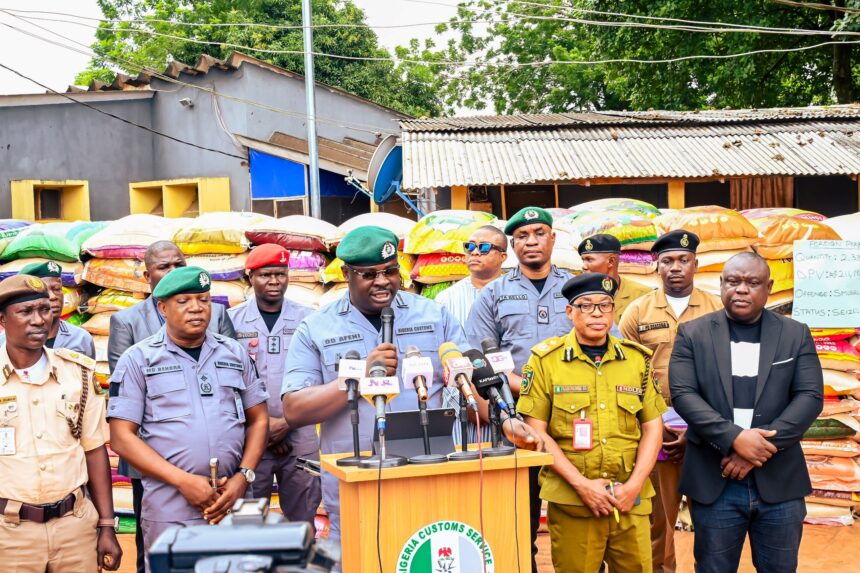
The Ogun I Area Command of the Nigeria Customs Service (NCS), operating along the country’s busiest border corridors with the Republic of Benin, has intensified its campaign against economic saboteurs while simultaneously facilitating legitimate exports.
At the centre of the campaign is the Acting Customs Area Controller of Ogun I Command, Deputy Comptroller Oladapo Olukayode Afeni, a career anti-smuggling officer, astute administrator with about two decades of experience across some of Nigeria’s most challenging borders and smuggling routes.
For Afeni, smuggling cannot be dismissed as a harmless commercial activity or merely a survival strategy, as its sponsors and practitioners often portray it.
Rather, he sees it as an economic and security threat capable of destroying local businesses, weakening government policy, depriving Nigerians of employment and exposing communities to dangerous substances.
“No nation can grow when its borders are gateways for criminality,” Afeni declared, stressing that the Customs Service would continue to make Ogun State increasingly hostile to smugglers.
The Hidden Cost Of Smuggled Rice
Few commodities illustrate the economic consequences of smuggling as clearly as foreign parboiled rice.
For years, smugglers have exploited Nigeria’s extensive land borders to move rice from neighbouring countries into the domestic market, often through remote routes and sophisticated concealment methods.
According to Afeni, the consequences extend far beyond lost Customs revenue.
He argued that the practice undermines Nigerian farmers, particularly rice producers across the North-East, North-West and North-Central regions, who have invested heavily in expanding domestic production.
Rice farmers in states like Borno, Yobe, Bauchi, Adamawa, Taraba, Zamfara, Sokoto, Kebbi, Kaduna, Katsina, Benue, Plateau, Kwara, Kogi and Nasarawa are among those affected when cheaper smuggled foreign rice competes with locally produced alternatives.
The impact, he said, is also felt by rice mills and other businesses that have invested billions of naira in processing capacity.
When smuggled rice floods the market, local producers struggle to compete, leaving some mills unable to operate profitably and threatening investments that were made in response to the government’s drive for self-sufficiency.
Afeni therefore views the fight against rice smuggling as part of the wider effort to protect domestic production.
He warned against health hazards, saying that some foreign parboiled rice are either re-bagged under unhygienic conditions or stored for prolonged periods in warehouses, potentially compromising its quality.
His assessment is based on years of direct involvement in anti-smuggling operations across several parts of the country, where Customs officers have intercepted foreign rice stored under questionable conditions.
How Ogun Became Smugglers’ Battlefield
Ogun State occupies a strategically important position in Nigeria’s trade and border security architecture.
Its extensive border with the Republic of Benin provides legitimate opportunities for cross-border commerce but also creates avenues that smugglers attempt to exploit.
Afeni said smugglers had increasingly resorted to sophisticated concealment methods and remote routes to move prohibited goods into Nigeria.
But the strategy is being countered by a combination of intelligence gathering, technology and aggressive frontline operations.
“Our intelligence networks, technological integration, and the raw determination of our officers on the frontline have proven superior,” Afeni said.
He added that the command had consistently dismantled smuggling networks, intercepted contraband and disrupted supply chains.
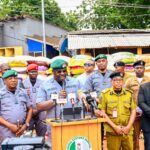
According to him, between July 17 and September 17, the command recorded a series of seizures involving foreign rice, illicit drugs, petroleum products, clothing, used vehicles and other prohibited goods.
Among the items displayed by the command were 3,543 bags of foreign parboiled rice, 70 cartons of basmati rice, 9,928 parcels of Ghana Loud/Indica, 30 bags of foreign sugar, 2,674 pieces of new shorts and trousers, 3,760 pieces of new tops and 91 bales of second-hand clothing.
The command also intercepted 20,125 litres of Premium Motor Spirit in kegs, 1,750 litres of PMS in drums, 50 kegs of diesel, 100 bags of fertiliser, 85 fire extinguishers, 480 cartons of Pure Haven drinks, 53 packages of oats, 47 cartons of cosmetics, 36 packages of hair accessories, seven packages of surgical shoes and 127 new purses.
The Command also made a major vehicle seizure, intercepting a 2026 Range Rover Sport Autobiography P530, which Afeni valued at N417 million as stated in his briefing.
The total Duty Paid Value (DPV) of the seized items in the last two months was put at N6.043 billion.
*Drugs: A More Dangerous Dimension*
From January to August 13, 2026, Ogun I Command handed over 32,412 parcels of hard drugs and 92 sacks of raw Cannabis sativa to the National Drug Law Enforcement Agency (NDLEA) Idiroko Special Command.
The handover underscores the increasing overlap between border control, public health and national security.
Afeni described the fight against drug trafficking as a collective responsibility requiring sustained collaboration among law enforcement agencies.
“The fight against drug smuggling is a collective responsibility. The Ogun I Command, under my leadership, remains resolute in its commitment to securing our borders and safeguarding our nation’s future,” he said.
“These are not just numbers; these are millions of doses of devastation that would have otherwise flooded our communities, fueled violent crimes, and ruined the lives of our youth,” he said.
“The true victory lies in seamless inter-agency collaboration as no single agency can secure our nation alone,” he said.
He warned about the wider criminal ecosystem associated with the illicit drug trade, arguing that the high profits generated by narcotics trafficking can finance other forms of organised crimes.
*Communities As The First Line Of Defence*
Behind the seizures is another important component of border enforcement: intelligence from border communities.
The Ogun I Command operates across communities including Ipokia, Yewa South, Yewa North and Imeko-Afon, where residents have first-hand knowledge of the terrain and movements around the border.
For Customs, information from these communities can prove decisive in identifying smuggling routes, warehouses and concealment methods.
The command’s increasing emphasis on intelligence therefore reflects a shift from simply reacting to smuggling attempts to disrupting networks before their consignments reach the market.
Afeni said the combination of community intelligence, technology and operational determination had helped the command choke smugglers’ supply lines.
Customs as Trade Facilitator
Yet the story of Ogun I Command is not entirely about enforcement. While Customs officers are pursuing smugglers, the same command is also facilitating legitimate trade and contributing to Nigeria’s non-oil export ambitions.
Between January and the period under review, Ogun I recorded 10,110 metric tonnes of exports with a Free On Board (FOB) value of N2.594 billion.
The major commodities driving the export performance included white talc, crushed thermal coal and Compressed Natural Gas (CNG).
The figures offer a glimpse into the potential of Nigeria’s non-oil economy and demonstrates the role that strategic border commands can play in moving locally produced commodities into international markets.
The modern Customs Service is expected not only to collect revenue and intercept prohibited goods but also to facilitate legitimate trade and support the economic objectives of government.
Afeni captured this wider mandate when he said, “The Nigeria Customs Service is not just a revenue-generating agency; we are the frontline shield protecting our domestic economy.”
The command also generated N180.066 million during the last two months under review from baggage assessments, auctions of perishable items, PMS and other charges.
Although the revenue figure is modest when compared with the broader national revenue requirements, it illustrates another dimension of the Customs mandate, ensuring that legitimate transactions and applicable duties are brought into the formal economy.
This becomes increasingly important as Nigeria seeks to broaden its revenue base and reduce dependence on crude oil.
*A Battle Over Nigeria’s Economic Future*
The Ogun I Command of NCS experience raises a larger question about the relationship between border security and economic development.
Nigeria cannot sustainably promote domestic production while allowing illicit imports to undermine the businesses producing those goods.
Similarly, the country cannot expect to expand non-oil exports if legitimate traders face unnecessary barriers while illegal operators exploit porous borders.
The two sides of Customs’ mandate, enforcement and trade facilitation, must therefore operate together.
Effective enforcement creates a more level playing field for compliant businesses, while efficient procedures encourage traders to remain within the formal economy.
This is particularly important for industries such as agriculture and manufacturing, where local investors require predictable market conditions to justify long-term investments.
Afeni had warned that smuggling offenders caught with prohibited goods would be arrested, their consignments seized and cases processed in accordance with the law.
“We will continue to put them on their toes, hit them very hard by making Ogun I Command hostile for them,” he said.
But the long-term success of the campaign will depend on more than seizures.
It will require sustained investment in border surveillance, intelligence, technology and personnel, as well as stronger cooperation among Customs, NDLEA and other security agencies.
It will also require the continued support of border communities and, perhaps most importantly, a change in consumer behaviour.
Similarly, every successful narcotics consignment represents not merely a commercial transaction but a potential threat to communities and young Nigerians.
Ogun I Command’s experience therefore offers a broader lesson: border enforcement is not an isolated security function. It is part of the country’s economic architecture.
The command’s N6.043billion worth of seized goods, 36,305 parcels of hard drugs and 92 sacks of raw cannabis handed over to the NDLEA, alongside 10,110 metric tonnes of legitimate exports valued at N2.594 billion, tell two sides of the same story.